Restorative Peptides: Present Applications And Future Directions
Healing Peptides: Present Applications And Future Instructions
Compared with noncovalent healthy protein medicines, PERx medicines can be used in their initial kind and do not require added modifications to prolong their half-life, since the covalent binding decouples the medicine efficiency from its pharmacokinetics. Moreover, PERx enables small-protein biologics such as PD-1 (15.6 kDa) to be utilized as therapeutics, thus significantly increasing the scope of therapeutic healthy proteins. Additionally, PERx can minimize the off-target effect due to the fundamental fondness between the healthy protein medication and its target, as well as the proximity-driven crosslinking system of the concealed bioactive ncAA. These advantages suggest that the PERx method has the prospective to offer a general system to create unique covalent protein drugs.- Our board-certified service providers review your laboratories, health background, and goals to produce a personalized peptide protocol.
- This quality suits the majority of in vitro research study applications-- receptor binding assays, enzyme task researches, and cell society experiments.
- Targeting the RAAS therefore stands for an excellent approach for managing heart diseases.
- A 95% purity indicates that out of every 100 "publications" in your set, 95 are ideal copies and 5 have some kind of error.
- Everything Lab Scientists Need to Understand About BPC-157 Study BPC-157 research continues to generate substantial scientific passion within regulated laboratory settings.

Links To Ncbi Databases
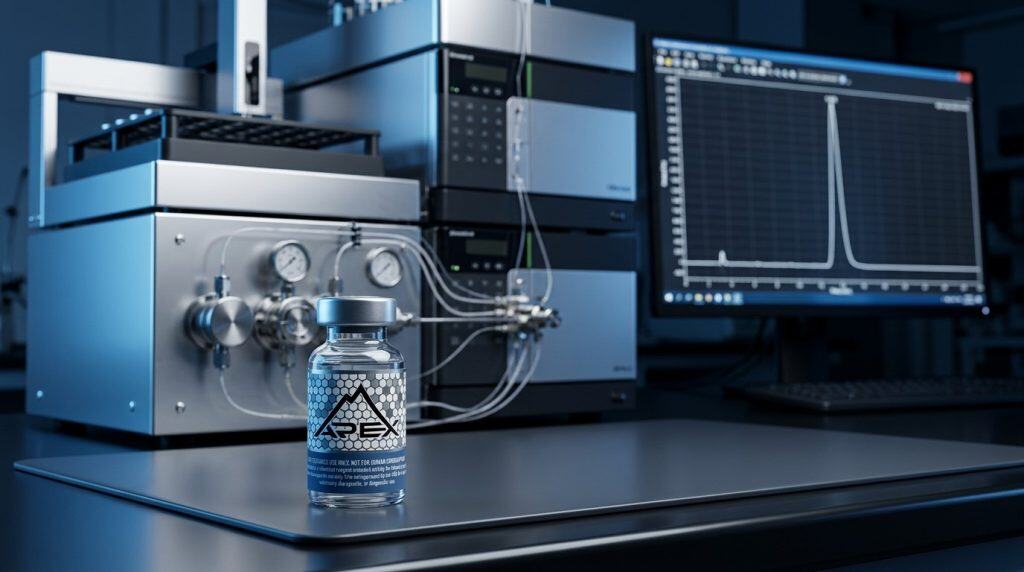
This batch-to-batch verification gives quality control throughout time and guarantees scientists have documentary proof for each and every order they position. High-Performance Liquid Chromatography stays the gold requirement for peptide pureness evaluation since it separates substances based on their chemical homes with exceptional accuracy. The resulting chromatogram display screens comes to a head representing various substances in the sample. The location under the primary peptide peak, compared to the complete location of all tops, determines the purity percentage. Research-grade peptides generally show a dominant height representing 99% or even more of the total area, with marginal pollutant heights.
If you see several large tops of comparable height, Homepage you're checking out either a low-purity example or a combination. If the primary top has a visible "shoulder"-- a bump on one side-- that usually shows a very closely relevant contamination (like a deletion peptide) that the column could not totally settle. A 2016 survey released in Nature found that greater than 70% of scientists had tried and failed to reproduce another scientist's experiments. While peptide purity isn't the only element, making use of poorly identified reagents is an acknowledged factor to irreproducible results. Peptides consisting of methionine or cysteine residues are vulnerable to oxidation. Methionine can be oxidized to methionine sulfoxide; cysteine can develop unwanted disulfide bonds or be oxidized to sulfinic or sulfonic acid derivatives.